The Bears' 4th-Worst Run Defense Isn't Terrible — It Just Bleeds on Early Downs
The Chicago Bears run defense ranks 4th-worst in yards per carry, but EPA data shows early-down explosive plays—not overall weakness—are the real issue.
If you glance at the standings-page version of the 2025 Chicago Bears run defense, you get one story. If you look at how the offense they're facing actually scores, you get a different one.
The box-score case for panic
Through the 2025 regular season, Chicago allowed 5.07 yards per carry on 452 designed rushes — the 4th-worst mark in the NFL, trailing only the Giants (5.63), Bengals (5.43), and Bills (5.21). The league average is 4.52.
It's also the highest YPC Chicago surrendered since 2022 (5.18) — worse than the 4.90 they gave up in 2024, and a jarring jump from 3.92 in 2023.
If you stop reading there — and most box-score summaries do — you conclude the Bears' run defense is one of the worst in football.
The EPA case for calm
Now sort the same 32 defenses by EPA per rush allowed, which weighs plays by how much they actually shift the odds of scoring:
| Metric | Bears | Rank (worst → best) | League avg |
|---|---|---|---|
| YPC allowed | 5.07 | 4th-worst | 4.52 |
| EPA/rush allowed | +0.0015 | 14th-worst (19th) | −0.006 |
| Success rate allowed | 45.6% | 8th-worst | 43.1% |
The EPA/rush figure is essentially league-median. Success rate — the share of runs that stay on-schedule for the offense — is a shade above average but nowhere near the top-five disaster the YPC number implies. Chicago allowed a ton of ground yardage without allowing a ton of damage.
There's only one way that math works: a small number of very long runs is doing almost all of the yardage work.
The boom-or-bust profile
Two splits tell the story:
- Explosive-run rate (10+ yards allowed): 13.05% — 7th-worst in the NFL, above the league average of 11.2%. Chicago has surrendered 13 runs of 20+ yards.
- Stuff rate (runs held to 0 or negative): 14.16% — 6th-worst. League average is 16.6%. Only Cincinnati, the Rams, Carolina, Philadelphia, and Detroit generate fewer negative runs per attempt.
So the Bears are simultaneously below-average at killing plays in the backfield and below-average at preventing the chunk gain. That's a defense with a wide variance profile: a lot of 4-yard gains sneak up to 6, and a handful of them go 30. Meanwhile, the ordinary, on-schedule runs are getting stopped often enough that success rate stays reasonable.
You can be miserable at the extremes and mediocre in the middle.
Where the damage actually lives: early downs
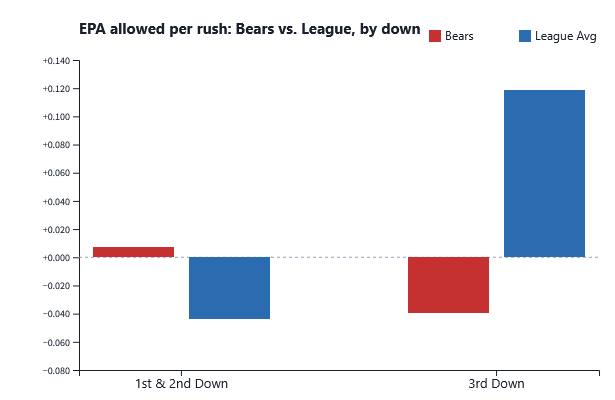
Split Chicago's rush defense by down and the pattern gets sharper:
| Down | Runs | YPC | EPA/rush |
|---|---|---|---|
| 1st & 2nd | 399 | 5.11 | +0.003 |
| 3rd | 46 | 4.09 | +0.069 |
On first and second down, Chicago is giving up 5.1 yards a pop and a 13.0% explosive rate — that's the leak.
On third down, they tighten. 4.09 YPC allowed against a league average of 4.57 on 3rd-down runs, and +0.069 EPA/rush allowed against a league-wide 3rd-down run EPA of +0.116. In other words, when offenses actually run on 3rd down against Chicago, they gain less value than they do on 3rd down against the average defense. The Bears rank 15th out of 32 in 3rd-down rush EPA allowed — right at league median.
So the sequence looks like this: Chicago concedes ordinary early-down runs, occasionally coughs up a 25-yarder, then holds up when the down demands a stop. That combination pumps up YPC while keeping the down-adjusted EPA roughly neutral.
What this reframes
The "Bears run defense is bad" narrative isn't wrong, exactly — 5.07 YPC is 5.07 YPC. Chicago isn't getting physically outmanned into a leaky floor; they're a middling stop unit with an explosive-play problem on early downs. The fix isn't "get tougher up front" as much as it is "stop giving up the 20-yarder on 1st-and-10."
That's a very different to-do list than the one the YPC ranking implies.
I'd want to see Chicago's early-down explosive rate come down before I called this a real problem for a playoff-caliber defense — but on the current evidence, the honest read is that the Bears' run defense is roughly league-average with a variance issue, not a bottom-five unit. Yards per carry, once again, is telling you what happened without telling you what it cost.
Author
Sign up for Stats Digest newsletters.
Stay up to date with curated collection of our top stories.